YOM TERUAH – Pay attention!
I’m so grateful for Rabbi Yuval from Israel, for helping me with this.
The Old Testament clearly states that the first month of the year is Nisan, the month of Passover.
Exodus 12:2
2 This month shall be unto you the beginning of months: it shall be the first month of the year to you.
But the old rabbis, through their many personal interpretations, established ‘Yom Teruah’ (The Blowing of the Shofar) as Rosh Hashanah, the beginning of the new year.
There are a few reasons. One of them is that the rabbis believe it is in the month of Tishrei when God created the world, specifically when He created Adam and Eve. Since it’s the creation of humanity, they felt it was appropriate to mark it as the new year. They also saw Rosh Hashanah as a Day of Judgment, when God reviews humanity’s deeds and determines their fate for the coming year.
If you read the Old Testament, you will clearly know this.
The shofar is sounded 100 times during a traditional Rosh Hashanah service. And a long and loud shofar blast marks the end of the fast day of Yom Kippur.
The shofar is a ram’s horn that is blown in synagogue on Rosh Hashanah and every day during Elul, the Hebrew month that precedes Rosh Hashanah. It is also blown at the conclusion of Yom Kippur.
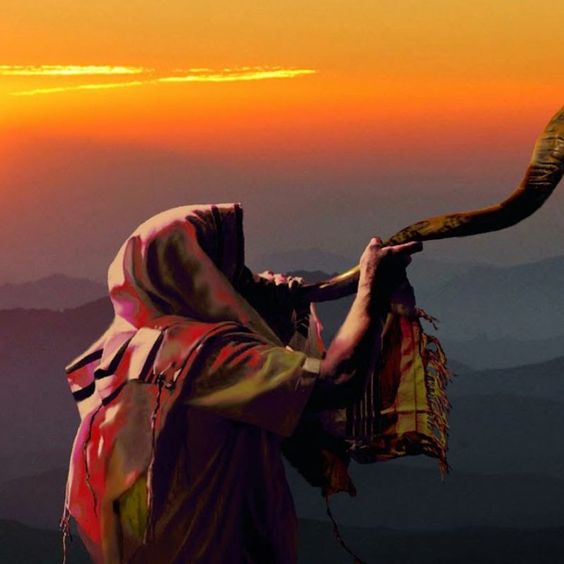
Different sounds of trumpets mean different things, but they are all calling for attention. The trumpet blast conveys a message.
There are three main types of shofar blasts — Tekiah, Shevarim and T’ruah. A fourth type, tekiah gedolah, is just a longer version of the regular tekiah blast.
Tekiah
Tekiah is a single blow. It’s a long, loud blast. If you’ve ever seen a knight or court messenger play a horn or blow a long sound to call attention to a king in a movie, tekiah, is kind of like that. When tekiah sounds, it brings everyone to attention.
Shevarim
The next type of sound made with the shofar is called shevarim. The three, broken blows of shevarim, sound like crying. Some scholars believe that shevarim is our tears of sadness, or joy, at another year passing.
T’ruah
The third type of sound made by the shofar blower is called t’ruah, and involes nine or more rapid fire, or staccato, blows. Think of this sound as an alarm clock that you can’t hit snooze on. T’ruah is the wake-up call to the new year.
Tekiah gedolah
The three sounds above are played all throughout the Rosh Hashanah service. And during the final combination, the shofar player concludes with tekiah gedolah, the great blast, one last, long tekiah to wrap up.
The first time the shofar is mentioned is in Exodus 19 at Mount Sinai, where the people of Israel trembled at the sounds of thunder and shofars. It was a truly awe-inspiring and nation-defining moment. God is calling Israel to cast their minds back to Sinai and the covenant He made with us there.
Shofars and trumpets in Scripture have many meanings and are mentioned almost 80 times in different contexts:
Here are some of them. Summoning the tribes to the door of the tabernacle, getting ready to up-tents and move on, as a warning, an announcement, inaugurating a new king, building, event or era, as a battle cry, a victory shout or the sound of rejoicing… Through the sound of the shofar, God calls His people to turn their minds and attention back to Him, back to heavenly matters.
Worship is so important to us. In many ways, worship is paying attention to God, giving him our time and “putting our hearts” with him… Being present, engaged, and focused. We remember God’s worth and come towards Him to give Him the love and honour He is due.
The blast of the shofar reminds us to forget self and remember God, putting His agenda at the front of our minds. It’s also an opportunity to remember our own personal “Sinai” event, where God invited us into covenant with Him and we said yes.
But when we look at ‘Yom Teruah’ described in the Bible, there’s very little information.
Leviticus 23:24
24 Speak unto the children of Israel, saying, In the seventh month, in the first day of the month, shall ye have a sabbath, a memorial of blowing of trumpets, an holy convocation.
That’s all there is. No detailed explanation, no long descriptions. It simply tells us to rest and blow the shofar.
So, what does this day really signify?

Everything God says, points to something significant, and ultimately, they all point to Jesus.
So, how does the blowing of the shofar fit into this?
I believe the answer lies in the shofar itself. The shofar is much more than just a trumpet. Throughout the Bible, it’s used to signal major events—calling Israel to battle, announcing victory, or proclaiming the crowning of a king. The sound of the shofar commands attention; it’s a spiritual wake-up call. But for us as believers, it also points forward to something far greater: the return of Jesus as the King of Kings and the Lord of Lords.
In the New Testament, we read that when Jesus returns, the shofar will sound, and the heavens will open.
1 Thessalonians 4:16
16 For the Lord himself shall descend from heaven with a shout, with the voice of the archangel, and with the trump of God: and the dead in Christ shall rise first:
This is more than just a loud noise; it’s the moment when the boundaries between heaven and earth dissolve.
The sound of the shofar represents the ultimate transition—the moment when Jesus returns as King to establish His Kingdom on earth.
It is the sound that announces His reign and the completion of God’s divine plan.
The shofar, in a way, symbolizes the moment when the heavens open wide and a bridge is built between the spiritual and physical realms.
It’s the fulfilment of the prayer, “Your Kingdom come, Your will be done, on earth as it is in heaven” (Matthew 6:10).
The shofar blast could be the very sound of the heavens expanding, as if the noise itself represents the breaking through of God’s Kingdom into our reality.
When we hear the shofar on ‘Yom Teruah’, we’re not just remembering something from the past—we’re hearing the future. We’re being reminded that there is still an ultimate shofar to be blown, a final blast that will signal Jesus’s return.
The sound of the shofar on Yom Teruah is a call to awaken, to be prepared for that day when heaven and earth will be fully united, and Jesus will return to establish His eternal Kingdom.
And who knows—maybe, on the day of Yom Teruah, or Rosh Hashanah, this will be the day that He will return.
Faithfully wait. He will return just as He said!
Willie Soans


